
Most brands believe they already have a customer engagement platform.
Messages are sent. Journeys are active. Dashboards are full. Yet retention keeps slipping. Repeat behaviour feels fragile. Loyalty outcomes rarely match the effort invested.
Something isn’t broken, it’s misaligned.
Over the past few years, engagement and loyalty have been bundled under the same language, sold as interchangeable layers, and measured through similar metrics. What used to be clearly separated is now blurred, and that blur is quietly shaping how brands design growth, retention, and customer relationships.
So what actually changed? Where does engagement stop and loyalty begin? And why do some platforms drive activity while others quietly shape behaviour over time?
This article examines the structural differences between a customer engagement platform and a customer loyalty program, why this distinction matters more than ever, and how retention shifts when loyalty is treated as infrastructure rather than a campaign layer.
Fasten your seatbelt, we’re about to pull these two concepts apart, piece by piece!
Why Engagement and Loyalty Are Often Confused?
The confusion didn’t happen by accident. It was engineered by language.
Over the last decade, martech platforms expanded fast and broadly. Tools originally built for messaging, automation, and journeys began adding rewards, badges, tiers, and “loyalty-like” features. At the same time, traditional loyalty programs started borrowing engagement language to sound more modern.
The result? Two fundamentally different systems began sharing the same vocabulary.
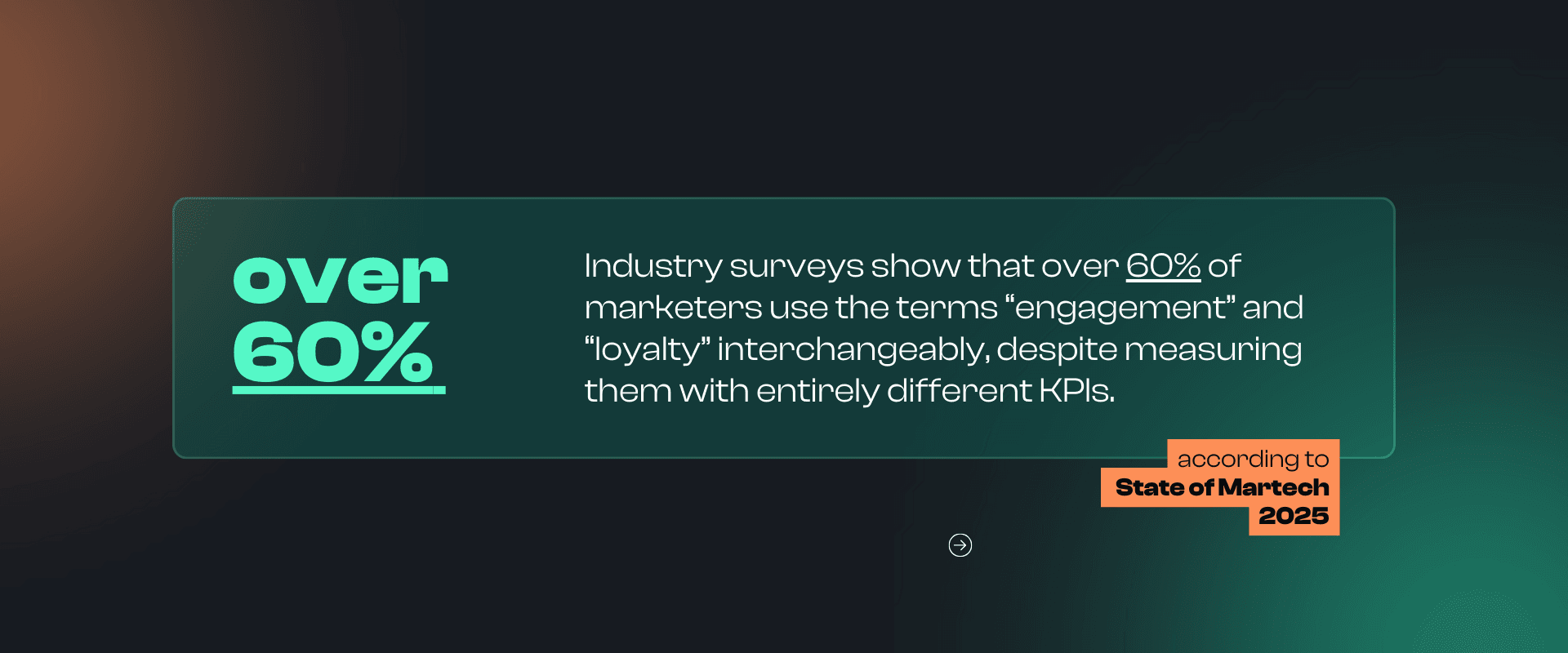
Engagement gets reported through opens, clicks, sessions, and campaign reach. Loyalty gets evaluated through repeat purchase rate, frequency, and customer lifetime value. When these metrics sit side by side in the same dashboards, the distinction quietly disappears.
Most content doesn’t help. Blog posts, vendor pages, and comparison articles often reduce the difference to surface features:
- Engagement platforms “communicate”
- Loyalty platforms “reward”
That framing is incomplete and misleading.
Engagement and Loyalty Solve Different Problems
- A Customer Engagement Platform is designed to trigger interaction.
Its job is to decide when to talk to a customer, where to reach them, and what message to deliver. It excels at responsiveness, orchestration, and real-time touchpoints.
- A Customer Loyalty Platform, by contrast, is designed to shape behaviour over time.
Its job is not to create moments, but to influence patterns: repeat visits, consistent choices, habit formation, and long-term preference.
This difference matters because:

Research consistently shows that brands can increase engagement metrics without improving repeat behaviour.
One global retention benchmark found that while brands increased campaign activity year over year, repeat purchase rates remained flat or declined across retail and hospitality. The activity was there. The behaviour wasn’t.
Engagement answers the question:
“How do we get customers to respond right now?”
Loyalty answers a different one:
“How do we get customers to come back, even when we’re not talking to them?”
Oversimplification Breaks Retention: Customer Engagement vs Customer Loyalty
When loyalty is treated as an extension of engagement, it becomes reactive.
- Points are added to campaigns.
- Rewards are triggered after transactions.
- Gamification becomes cosmetic.
But behaviour doesn’t change because it was never designed to.
That’s why many brands feel stuck: high message volume, active journeys, impressive engagement dashboards, and yet fragile retention.
The problem is the assumption that engagement alone can carry loyalty outcomes. Understanding where engagement ends and loyalty begins is the first step toward building customer retention software that doesn’t just activate customers but keeps them.
And this is where the real structural difference starts to matter.
What a Customer Engagement Platform Is Designed to Do?
A Customer Engagement Platform exists to manage interaction at scale.
Its core purpose is orchestration: deciding when, where, and how often a brand should appear in a customer’s journey. Messaging logic, channel selection, and timing sit at the heart of its design.
Engagement platforms are built to answer questions like:
- Which message should be sent right now?
- Through which channel will it perform best?
- What happens if the customer clicks, ignores, or exits?
- How do we keep the conversation going?
To do this well,
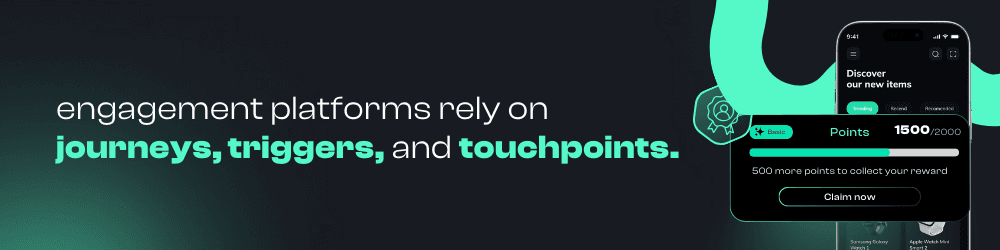
They connect behavioural signals to outbound actions, turning data into communications that feel timely and responsive.
When configured properly, they help brands stay present across email, push, SMS, in-app, and on-site moments without overwhelming the customer.
This makes them extremely effective at activation.
- They increase interaction frequency.
- They reduce response friction.
- They help brands react faster to customer signals.
Where engagement platforms struggle is not execution, but scope.
Their success is measured by immediate reactions: opens, clicks, views, sessions, conversions within a defined window. These are valuable signals, but they describe moments, not patterns.
Engagement platforms optimise for the next interaction, not the next habit. As a result, retention often becomes a secondary outcome rather than a designed one.
A customer may open more emails, tap more notifications, or respond to more campaigns without forming a stronger preference for the brand. Activity increases, but behaviour doesn’t necessarily stabilise.
The platform did exactly what it was built to do: drive interaction. It simply wasn’t built to answer a deeper question: What makes this customer choose us again, without being prompted?
This limitation doesn’t make customer engagement platforms flawed. It makes them specialised.
- They are excellent at keeping conversations alive. They are not designed to define why those conversations should change long-term behaviour.
And that distinction becomes critical when brands expect engagement tools to deliver retention outcomes they were never architected to produce.
What a Loyalty Platform is Actually Built For?
A loyalty platform is built to shape behaviour, not chase attention.
Its role is to design repeat actions over time: coming back more often, choosing the brand consistently, and building habits that last beyond individual campaigns.
In loyalty programs,
- Rewards play a supporting role, not the end goal.
- Points, tiers, access, and gamification exist to reinforce progress and signal momentum.
- When timed correctly, rewards create anticipation and commitment.
- When treated as the objective, they become short-lived incentives with no behavioural impact.
This focus on behaviour matters because retention doesn’t come from activity alone.
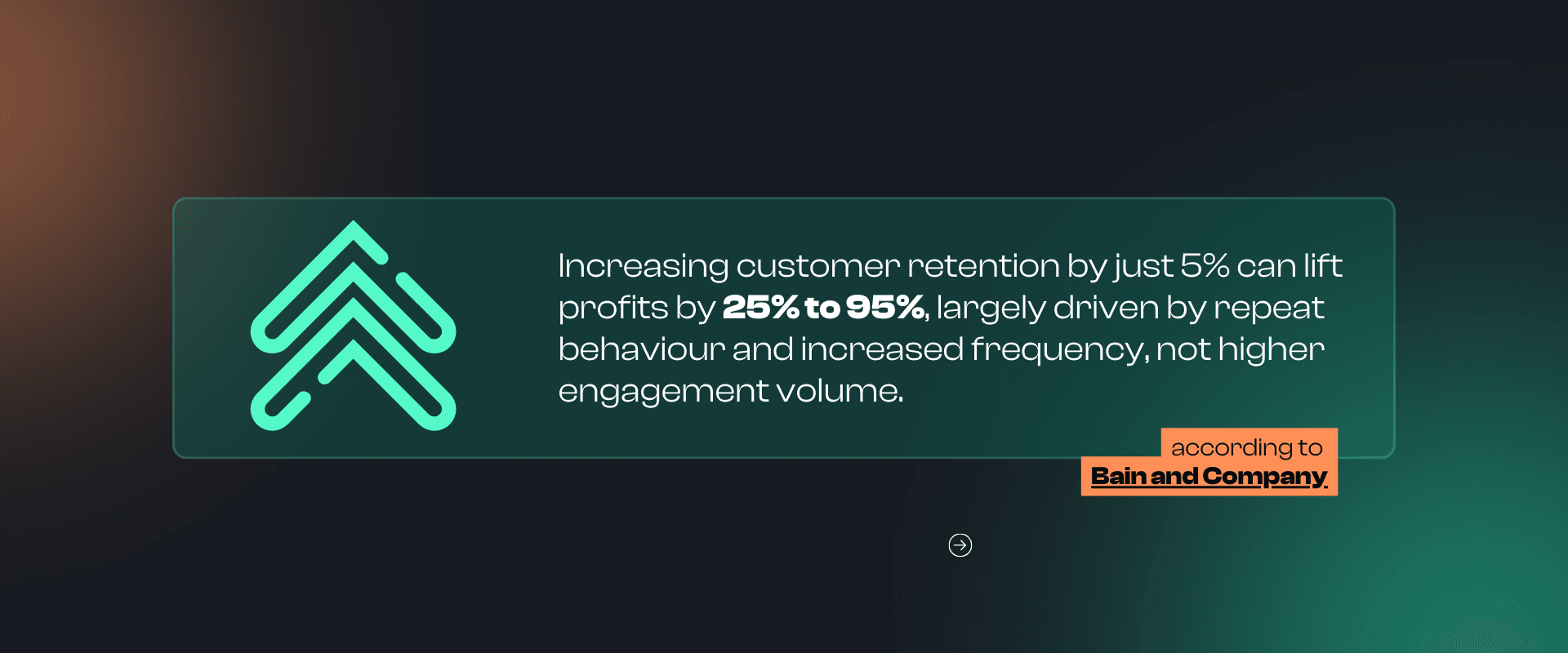
A well-designed loyalty platform works even when messaging stops. Customers return because the structure is already there: progress is visible, status is understood, and the next action feels natural.
That’s the real purpose of loyalty infrastructure: making repeat behaviour the default, not the result of constant reminders.
Customer Engagement Platforms vs Loyalty Program Platforms: A Structural Comparison
By now, the difference should be clear.
- Customer engagement platforms are built to activate customers in the moment.
- Loyalty platforms are built to shape what customers do next, and what they do repeatedly.
Both matter. Both can coexist. But they are not interchangeable. Engagement focuses on touchpoints. Loyalty focuses on patterns.
One optimises how often and how well you communicate.
The other designs the behaviours that drive retention, frequency, and lifetime value.
To make these structural differences easier to spot at a glance, the table below breaks down how customer engagement platforms and loyalty platforms differ across purpose, metrics, time horizon, and business impact.
Dimension
| Customer Engagement Platform
| Loyalty Platform
|
|---|---|---|
Primary Purpose | Drive interaction and responsiveness | Shape repeat behaviour and long-term preference |
Core Question It Answers | “How do we get the customer to respond right now?” | “How do we get the customer to come back again?” |
Time Horizon | Short-term, moment-based | Long-term, cumulative |
Focus | Touchpoints and communication | Patterns, habits, and progression |
Primary Metrics | Opens, clicks, sessions, reach, conversions | Repeat purchase rate, frequency, retention, customer lifetime value |
Value Created | Attention and activity | Retention and compounding value |
Role of Rewards | Often campaign-driven or transactional | Behavioural reinforcement mechanism |
Impact When Messaging Stops | Interaction drops quickly | Behaviour often continues |
Typical Outcome | More conversations | Stronger customer preference |
Gamified Loyalty Is Not an Engagement Tactic: Why?
Gamified loyalty is one of the most misunderstood concepts in retention vs engagement vs loyalty discussions.
Badges, progress bars, challenges, streaks, tiers… they often get grouped under “engagement features” because they look interactive. But interaction is not their job. Behaviour change is.
When gamification is treated as an engagement tactic, it becomes decorative.
A badge after a click.
- A spin-the-wheel after a purchase.
- A short-term spike in activity that fades as soon as the novelty wears off.
- That’s not gamified loyalty. That’s visual engagement.
True gamification belongs to loyalty because its purpose is not to generate a response in the moment, but to influence what happens next.
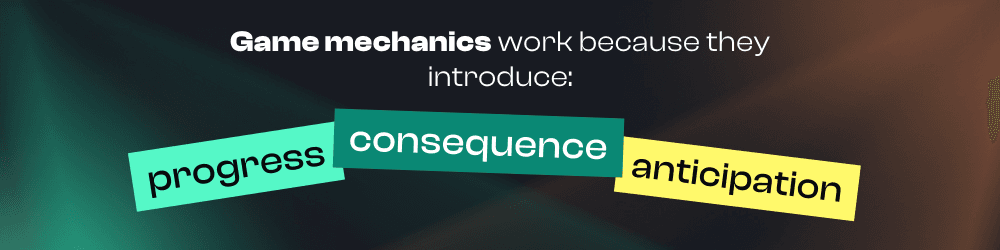
They make actions feel connected. A customer doesn’t just complete an action; they move closer to something. Status improves. Access unlocks. Momentum builds.
This is fundamentally different from engagement logic because game mechanics reinforce repeat behaviour so effectively when used correctly.
Behavioural science backs this up. Studies in behavioural science show that people are far more likely to repeat actions when progress is visible and rewards are tied to completion rather than one-off participation.
When gamification lives inside an engagement tool, it usually resets every campaign. When it lives inside a loyalty platform, it compounds over time.
This distinction matters because retention is cumulative. Customers don’t become loyal because they click often. They become loyal because each action feels like part of a journey.
Gamified loyalty works when it’s designed as infrastructure, not as a moment.
And that’s why gamification isn’t an engagement feature. It’s a loyalty mechanism.
Retention and Engagement Are Systems. Loyalty Is the Infrastructure.
Engagement and retention don’t fail because brands lack activity. They fail when activity isn’t connected to behaviour.
Customer engagement platforms orchestrate conversations. Loyalty platforms shape what happens after the conversation ends.
When loyalty is treated as infrastructure, not a feature, repeat behaviour becomes intentional. Engagement works harder, rewards gain meaning, and retention stops relying on constant messaging.
That’s the shift modern brands need to make.
If your engagement tools create activity but not retention, it may be time to rethink how loyalty fits into your growth strategy, and whether it’s designed as a system, not a campaign.
Explore how Kaizen helps brands design loyalty as a behavioural infrastructure for long-term retention.