


Third-party data once made growth feel smooth. You could define a segment, activate it instantly, and watch performance scale with reassuring predictability.
Many growth teams built entire roadmaps around that process.
Then the entire structure changed.
Privacy updates, browser restrictions, and platform guardrails didn’t cause a dramatic collapse. They introduced subtle instability.
- Audiences shrank.
- Attribution models disagreed.
- Acquisition costs climbed without an obvious explanation.
The deeper we studied loyalty, the clearer it became: most brands were scaling on visibility they didn’t actually own.
In this blog, we’ll unpack why that model is breaking in 2026 and how loyalty platforms can help you shift from rented visibility to owned customer relationships.
What is Third-Party Data and What Does It Mean for Businesses?
Third-party data is information collected by an external organization and sold or shared with other companies for marketing and advertising purposes.
The brand using the data did not gather it directly from its own customers.
Data brokers, ad networks, and large digital platforms typically compile this information by tracking activity across websites, apps, and devices. Cookies, mobile identifiers, and cross-site behaviour feed into large audience pools that can then be segmented and activated for campaigns.
For example,
- A user reads travel blogs, searches for flights, and compares hotel prices across multiple sites.
- An ad platform aggregates those behaviours and categorizes that user as a “frequent traveler.”
- A hospitality brand can then target that segment without ever interacting with the individual directly.
The brand benefits from the classification, though it does not own the underlying behaviour data.
That distinction matters.

Instead of waiting to collect insights through direct engagement, businesses could access ready-made segments such as:
- High-income urban shoppers
- Parents with young children
- Luxury travelers
- Lapsed retail buyers
Why Third-Party Data Stopped Working by 2026
Third-party data felt like a shortcut to scale. It offered ready-made audiences, fast activation, and the comforting impression that brands could “understand” customers simply by targeting the right segment at the right time.
Most teams have seen the same story in slide decks.
- “Frequent travellers with high expenses.”
- “Young professionals in urban centres.”
- “Lapsed customers are likely to return.”
Platforms could serve these segments on demand, performance often looked stable, and retargeting made it easy to believe the relationship was strengthening.
The problem is that these segments were never in a relationship. They were a proxy.
Behind the scenes, profiles were assembled from cookies, device IDs, and cross-site behaviour that brands could not fully verify, audit, or carry into their own systems. Even when the results looked good, the visibility was borrowed.
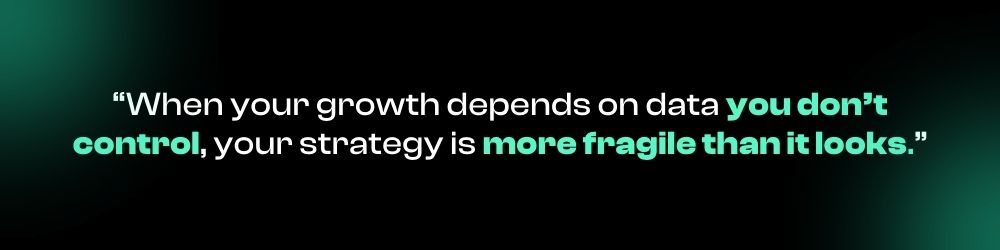
That’s why this model weakens so quickly when the rules change. Browser restrictions, privacy updates, and platform limitations do not just reduce performance. They reduce control. And when control shrinks, “customer understanding” turns out to be much thinner than it seemed.
Third-Party Data Changes: What Changed Technically and in Regulation
Third-party data didn’t suddenly stop working. The infrastructure that made it usable was dismantled piece by piece, both by browsers and regulators.
For years, most audience signals were tied to cookies set by domains other than the one the user visited, “third-party cookies.” Those cookies enabled cross-site tracking and audience building because they let platforms recognise the same browser across multiple web domains.
Major browsers such as Safari, Firefox, and Microsoft Edge began blocking third-party cookies by default, and even where they weren’t blocked, users could delete them or turn them off.
Meanwhile, industry attempts to replace third-party cookies with privacy-preserving alternatives, like Google’s Privacy Sandbox, were ultimately discontinued in late 2025 after adoption stalled and regulatory pressure mounted.
In parallel, privacy laws around the world (such as GDPR in Europe and a growing patchwork of state-level privacy laws in the U.S.) increased requirements for consent and transparency around tracking, making it harder to rely on inferred signals without explicit user permission.
The result is not simply fewer cookies. It’s a world in which the identifiers that once underpinned audience construction and cross-site retargeting are no longer widely available, consensual, or reliable.
How the Loss of Third-Party Cookies Impacts Marketing Performance
The impact of third-party decline rarely arrives as a dramatic crash. It surfaces inside the numbers teams review every week.
Retargeting audiences that once refreshed automatically begin to thin out. Frequency controls that used to feel precise start overserving some users while missing others entirely. Lookalike models rely on smaller and less consistent seed pools, which makes scaling less reliable.
Acquisition costs begin to move in one direction…Upward.
Attribution adds another layer of friction. Different platforms report different outcomes for the same campaign. Assisted conversions blur into direct ones. Cross-channel journeys become harder to stitch together because the identifiers that once connected them no longer persist.
Individually, each shift looks manageable. Collectively, they change the economics of growth.
Performance teams often respond the way they always have:

Those actions still matter, though they no longer restore the original efficiency. Optimisation becomes incremental rather than transformative because the underlying signal density has changed.
The result is subtle but important. Scaling requires more spending to achieve the same return. Forecasting becomes less confident. Growth conversations include more caveats.
This is where structural data ownership begins to matter operationally, not philosophically. When external identifiers weaken, the most stable signals are the ones generated inside your own ecosystem, such as transactions, engagement patterns, reward participation, and repeat behaviour.
Performance does not disappear in a cookieless world. It shifts toward environments where identity is durable, and participation is direct.
That shift is exactly where loyalty platforms begin to move from campaign support to growth infrastructure.
| Dimension | Before (Peak Third-Party Era) | Now (2026 Reality) |
|---|---|---|
| Data Collection Method | Persistent third-party cookies and device IDs track users across sites | Cookies blocked or restricted by major browsers; identifiers limited or short-lived |
| Audience Building | Large, stable retargeting pools refresh automatically | Shrinking pools as identifiers expire or fail to sync |
| Lookalike Modeling | Built on broad, high-volume behavioural seed data | Built on thinner, fragmented seed pools with lower consistency |
| Frequency Control | Cross-site recognition enables balanced ad exposure | Gaps in identity cause overserving or missed impressions |
| Attribution | Cross-channel tracking connects journeys with relative consistency | Fragmented identifiers create conflicting reports across platforms |
| Customer Acquisition Cost (CAC) | Predictable scaling efficiency at volume | Rising CAC as platforms optimise with less reliable signals |
| Data Ownership | Platforms hold and manage identity resolution | Brands have limited visibility and limited portability |
| Forecasting Confidence | Historical performance patterns remain stable over time | Increased volatility and reduced forecasting reliability |
| Strategic Risk | Growth tied to platform access, though rarely questioned | Platform dependency exposed as structural vulnerability |
What Replaces Third-Party Data in 2026?
What replaces third‑party data in 2026 is not a single tactic but a new economic logic of identity built on owned signals, and the numbers show why this matters.
Brands with robust first‑party strategies see better performance dramatically while reducing reliance on rented identifiers, with first‑party campaigns often delivering 3–5× the performance at a fraction of the cost compared with third‑party retargeting and audience buys.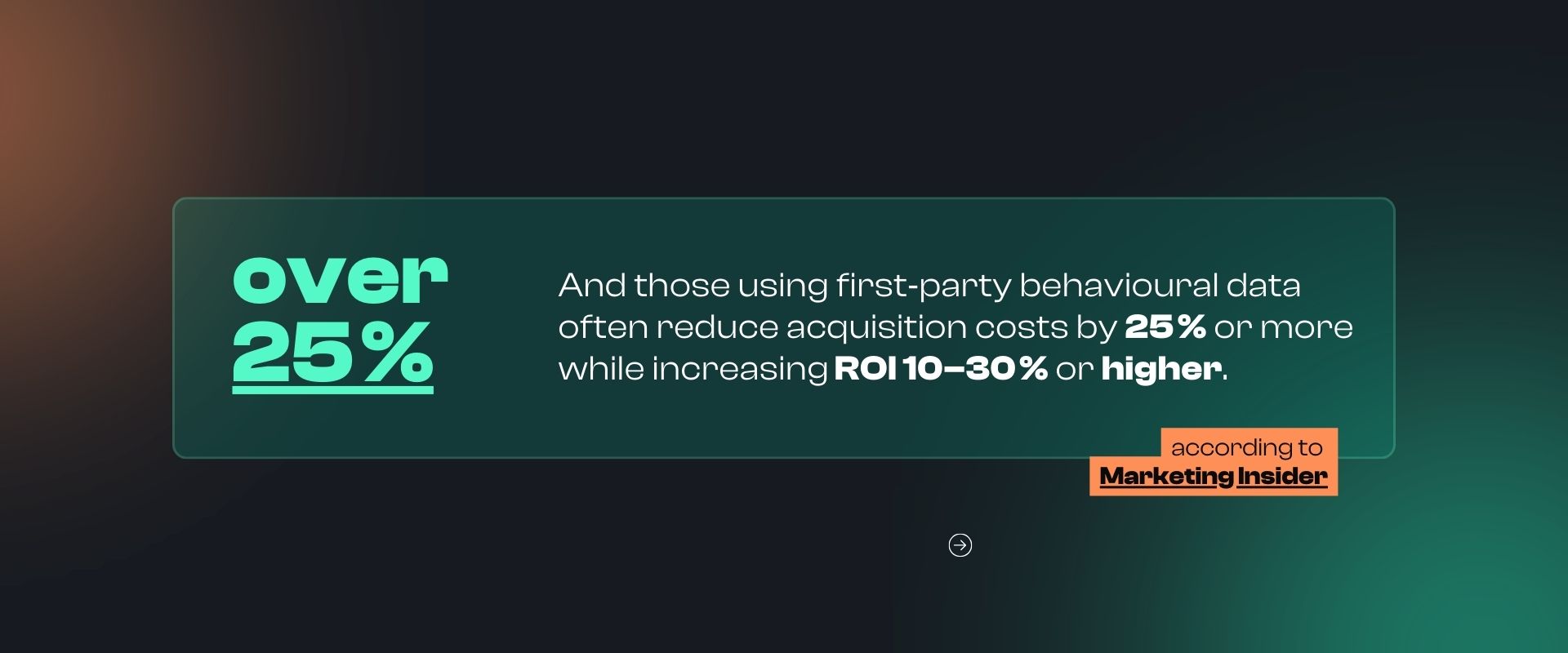
The structural shift arises because third‑party cookies and device identifiers are no longer a reliable foundation; most browsers now block or restrict them by default, and privacy laws like GDPR and CCPA demand explicit consent, making probabilistic segments less accurate and sustainable.
In contrast, loyalty platforms and first‑party systems collect data directly from customers who willingly interact with the brand (purchases, reward redemptions, preferences and engagement flows), creating a durable, consented identity graph that strengthens with each interaction instead of fading when a cookie expires.
That shift changes how growth scales: acquisition becomes more predictable because campaigns are informed by real transactional and engagement data; retention improves because signals are persistent and can be acted on across channels; and personalisation becomes more accurate because behaviour comes from observed customer actions rather than inferred browsing.
In this environment, loyalty platforms don’t just support marketing, they become structural customer systems that power segmentation, lifecycle journeys, and audience activation across performance, CRM, product and experience, turning every direct interaction into an asset rather than a borrowed signal.
Visibility Is Earned Now
Third-party data once made growth feel predictable. But as those signals weaken, brands are discovering that visibility built on rented access cannot last.
Loyalty changes that equation. When designed as a structured system rather than a promotional tool, it transforms everyday interactions into durable insight. Participation becomes intentional. Behaviour becomes measurable. Growth becomes more resilient.
The brands that adapt in 2026 will not be the ones collecting the most data. They will be the ones designing environments where customers willingly engage, share, and return.
Kaizen helps brands build loyalty platforms that turn direct interactions into long-term strategic advantage. If your growth depends on signals you truly own, it may be time to rethink how loyalty is structured.
Book a demo to explore how Kaizen can help you move from rented visibility to owned relationships.