
Post-Purchase Experience: How to Turn Buyers Into Loyal Repeat Customers
Most ecommerce marketing investment is concentrated in the pre-purchase journey: driving traffic, optimising the product page, recovering abandoned carts. The moment a customer clicks confirm order, the majority of brands go quiet. This is a commercially significant mistake. The post-purchase window, the hours and days immediately after a transaction, is when a customer's emotional investment in the brand is at its peak. How that window is managed determines whether a first purchase becomes a second, and whether a second-time buyer develops the habitual relationship that constitutes genuine loyalty.
Repeat customers generate 40% of revenue for most ecommerce stores despite representing a fraction of the total customer count. Shoppers who have made two prior purchases are 50% more likely to buy again, and repeat customers spend 25% more per transaction than first-time buyers. The entire economic case for retention investment rests on the behaviour that begins the moment the first order is placed.
What is the Post-Purchase Experience?
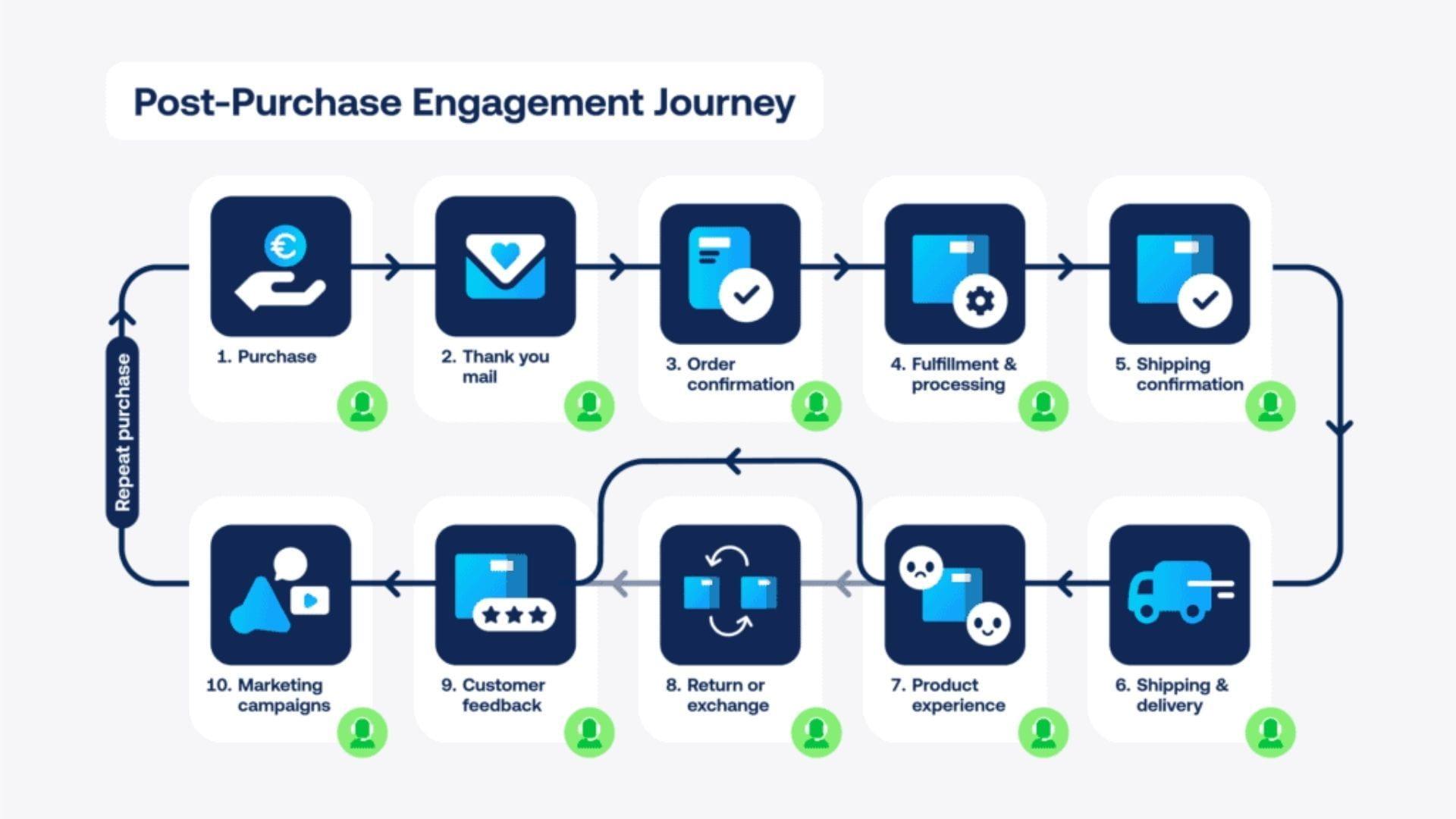
The post-purchase experience is the totality of interactions, communications, and physical experiences a customer has with a brand after completing a transaction, from the order confirmation to the delivery of the product, through any subsequent service interactions, and into the follow-up communications that determine whether the customer returns.
It is not a single touchpoint but a sequence of moments, each of which carries independent influence over the customer's perception of the brand. A smooth checkout experience followed by a week of silence and a delayed delivery does not produce a satisfied customer. Conversely, a brand that communicates proactively, delivers reliably, packages thoughtfully, follows up relevantly, and handles returns with minimal friction creates a cumulative experience that makes returning feel natural rather than deliberate.
The post-purchase phase is also where brands generate the data and consent signals needed to power personalised marketing. Every confirmed order is a permission event, a transaction data point, and a relationship moment simultaneously.
Why Post-Purchase Matters More Than the Sale?
The commercial logic for investing in post-purchase experience is straightforward: the cost of converting an existing customer to a repeat purchase is substantially lower than the cost of acquiring a new one, and the margin on that second purchase is higher because the acquisition cost has already been absorbed.
The emotional logic is equally significant. A customer who has just purchased is, by definition, a customer who already believes in the product. Their trust has been extended. The post-purchase experience either confirms that trust or erodes it. Research from Zendesk indicates that 76% of customers will leave a brand after two poor service experiences, but 78% will forgive a bad experience if the recovery is handled well. This asymmetry in how customers respond to failure and recovery makes post-purchase service investment one of the highest-leverage retention activities available.
The scale of the opportunity is compounded by how poorly most brands execute it. Despite the commercial evidence, many customers report feeling abandoned after checkout, receiving generic transactional communications, and having no structured path back into the brand's purchase journey.
Key Stages of the Post-Purchase Journey
Order Confirmation and Fulfilment
The order confirmation is the first post-purchase communication a customer receives, and it carries the highest open rates of any email type in ecommerce. It should do considerably more than confirm the order number. It should re-affirm the purchase decision, set precise delivery expectations, provide a branded tracking experience rather than a generic carrier link, and introduce the customer to any loyalty programme benefits they are entitled to or eligible to join.
The communication cadence through the fulfilment window matters as much as the content of individual messages. Customers who receive proactive shipping updates report significantly lower anxiety and significantly fewer inbound enquiries about order status. Research from parcelLab indicates that brands with structured post-purchase communication see 20% fewer customer service enquiries and 15% fewer complaint emails compared to those with minimal fulfillment communication. Each of those avoided contacts is a cost saving and a prevented dissatisfaction event.
From a loyalty programme perspective, this is also the moment to enrol a new customer into the programme while their purchase motivation is highest. Post-confirmation enrolment flows that connect the programme's value proposition directly to the purchase just made achieve materially higher enrolment rates than standalone sign-up campaigns.
Delivery and Unboxing
Delivery is the physical culmination of the digital promise. In 2025, 76% of shoppers reported that a positive delivery experience directly influenced their decision to repurchase, up from 72% the previous year. Nearly half of consumers stop buying from a brand after experiencing poor delivery or damaged packaging. The unboxing moment, the point at which the product is physically received, is when the brand's quality signals are transmitted in their most tangible form.
Only 56% of ecommerce brands use branded packaging, and only 36% include inserts or samples that enhance the unboxing experience, according to Stord's 2025 Mystery Shopping Report. This is a significant gap between what consumers value and what brands deliver. Packaging that reflects brand quality, includes a personalized message or loyalty programme invitation, and presents the product in a way that matches the expectation set by the product page adds perceived value without requiring a price reduction.
Speed remains a primary driver of delivery satisfaction. Consumer expectations around delivery windows have compressed continuously since the accelerated adoption of ecommerce during 2020 to 2022. The operational investment required to meet those expectations is significant, but the retention cost of consistently failing them is higher.
Follow-Up and Feedback
The days immediately following delivery are the most commercially productive window for follow-up communication. A review request sent two to four days after confirmed delivery, while the product experience is fresh, generates both higher response rates and more detailed feedback than one sent weeks later. Review volume and quality have a direct positive effect on conversion for subsequent customers, creating a compounding commercial benefit from consistent post-delivery feedback collection.
The follow-up communication sequence should be structured to deliver value before it requests anything. A product usage guide, a styling suggestion, or a complementary product recommendation delivered before a review request positions the brand as invested in the customer's experience rather than simply harvesting data. Personalised follow-up emails referencing the specific product purchased achieve 20% to 30% higher customer lifetime value through better retention, compared to generic post-purchase sequences.
Where feedback indicates a problem, the speed and quality of the resolution has a disproportionate effect on long-term retention. Customers who experience a problem that is resolved quickly and generously often develop stronger brand relationships than those who never experienced a problem.
Return and Exchange
Ecommerce return rates averaged 16.9% in 2024 and are projected to have reached 24.5% in 2025. Returns are not an anomaly of ecommerce; they are a structural feature of it, driven by the absence of physical trial before purchase. How a brand manages that feature determines whether a returning customer remains a customer at all.
Fifty-eight percent of consumers prefer no-questions-asked return policies, and 62% are more likely to make an online purchase if in-store returns are available. These preferences converge on a clear commercial principle: the return process should add zero friction to the customer relationship. A return that is easy and well-communicated preserves the relationship even when the original product did not meet expectations.
The opportunity within returns is often overlooked. AI-driven return management systems can convert over 50% of returns into exchanges rather than refunds, retaining the revenue within the transaction while resolving the customer's dissatisfaction. A customer who returns a product and receives an exchange recommendation that works for them has had a better experience than one who simply kept a product they were ambivalent about.
How Loyalty Programmes Enhance Post-Purchase?
A loyalty programme transforms every stage of the post-purchase journey from a transactional interaction into a relationship event. Points credited on the order confirmation email are not simply a financial mechanism; they are a signal that the purchase has been recognised and that the relationship has a continuation value beyond this transaction.
The clearest commercial application is accelerating the second purchase. A customer who has just received a point credit is closer to a reward than they were before the purchase. Communicating that proximity, specifically "you are now 50 points away from a £10 reward," creates a goal that motivates the next purchase visit before the habitual relationship has been established through frequency alone.
Loyalty data accumulated across post-purchase interactions, review submissions, feedback responses, and product usage signals, enables the personalisation of subsequent communications at a level that generic segmentation cannot reach. A member who purchased skincare for the first time and left a detailed positive review is a different follow-up opportunity from one who purchased the same product and has not engaged with any subsequent communication. The programme's data layer makes that distinction visible and actionable.
The return experience also benefits from loyalty integration. A loyalty programme member who receives their return confirmation alongside a prompt showing their current reward balance and what they can earn on their next purchase is being retained in the commercial relationship even at the moment of a potentially negative experience.
Post-Purchase Experience Examples
H&M's loyalty programme introduces itself at confirmation, with an enrolment conversion rate of over 50% among first-time buyers. The programme's post-purchase sequence delivers points confirmation, delivery tracking integrated with app experience, and a review incentive tied to points earned, creating a structured retention path from the first order.
Dollar Shave Club's post-purchase communication strategy centres on the "Toss More In?" mechanic, deployed immediately after order confirmation while the customer is still in a purchasing mindset. The prompt adds complementary products with a single interaction, increasing average order value and introducing cross-category purchasing behaviour that improves long-term retention.
Amazon's post-purchase experience operates at scale through delivery speed, proactive communication, and a returns process that has set the operational standard for the entire ecommerce category. Its contribution to consumer expectation is itself a competitive challenge for every brand that cannot match its logistical infrastructure, which makes post-purchase differentiation through personalisation and loyalty mechanics the more achievable competitive lever for mid-market brands.
ASOS structures its post-purchase experience around flexible delivery options, a generous returns window communicated prominently at confirmation, and a loyalty programme that credits points at the post-purchase stage before the return window has closed, signalling confidence in the transaction before the customer has resolved their assessment of it.
Metrics to Track Post-Purchase Success
Repeat purchase rate is the primary measure of whether post-purchase investment is working. The ecommerce average sits at 28.2%, with rates below 20% indicating that the post-purchase experience is not generating sufficient motivation to return. Loyalty programme active members should show materially higher RPR than non-enrolled customers, and the size of that gap is the clearest measure of the programme's retention contribution.
Time to second purchase measures how quickly customers who do return make their second transaction. A shorter time-to-second-purchase indicates that the post-purchase communication sequence is successfully pulling customers back into the purchase journey rather than waiting for organic re-engagement.
Post-purchase email engagement rate tracks whether the communication sequence is being opened and acted on. A declining open rate over the sequence indicates either content irrelevance or communication fatigue, both of which are diagnostic signals rather than conclusions.
Return rate by product and acquisition cohort reveals which products are generating the highest dissatisfaction signals and whether specific customer acquisition groups are returning at disproportionate rates. Returns analytics that identify product-level root causes, for example, consistent feedback that a product runs small, allow operational fixes that reduce returns at source rather than simply processing them more efficiently.
Net Promoter Score at 30 days post-purchase captures whether the overall post-purchase experience has produced an advocate or a detractor. A 30-day NPS measurement timed after most customers have received, used, and formed an opinion about their product provides a leading indicator of which cohorts are building toward advocacy and which are at risk of churn before any repeat purchase behaviour has been expressed.
Loyalty programme enrolment rate from post-purchase flows measures the commercial effectiveness of the confirmation and follow-up sequence as a programme growth mechanism. A high enrolment rate from post-purchase communication is both a retention success and an acquisition cost reduction: enrolled members cost less to retain and generate more long-term revenue than non-enrolled buyers acquired through the same channel.